

Puzzle – metal tiles (set of 18)
Stainless steel / 120 x 60 cm
2.999,00 zł
Sale price
2.999,00 zł
Regular price
Skip to product information



Puzzle – metal tiles (set of 18)
2.999,00 zł
Sale price
2.999,00 zł
Regular price
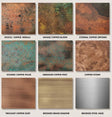
Nie masz pewności, które wykończenie wybrać?
Zamów próbki wykończeń metalowych i zobacz kolor, strukturę oraz refleksy światła na żywo przed większym zamówieniem.
Zamów próbki wykończeń metalowych →Eighteen tiles that don't create a repetitive rhythm – they form one continuous composition. Arches and angles transition from tile to tile, and the boundaries between them disappear when viewed from a distance. It's a pattern that reads like a painting, not wallpaper. The best way to see the depth of the material and the texture of the pattern is to see real metal in an interior.
See Puzzle tiles in a real interior
The best way to see the depth of the material, the texture of the pattern, and the effect of light on real metal is to watch the composition in a finished interior.
Why choose Puzzle tiles?
- Real metal — each tile is made from an authentic sheet of copper, brass, or stainless steel, depending on the chosen variant. Not foil, not print, not imitation.
- Continuous pattern — 18 tiles form one composition, not a grid of identical pieces. Arches extend across tile boundaries.
- Handmade — each tile is patinated individually, so no two sets are exactly alike.
- Light and depth effect — the metal surface changes depending on the viewing angle, lighting, and time of day.
- Scale — four sizes up to 240 × 120 cm. The largest covers a full wall behind a bed or sofa.
Available materials
Puzzle tiles are available in three noble metal variants. Each creates a different visual effect and allows you to match the decoration to the character of the interior.
- Copper — warm, deep, and expressive. It gives the interior a more artistic, luxurious character and pairs beautifully with wood, black, stone, and dark built-in furniture. Patina settles into the grooves of the pattern and deepens over time.
- Brass — elegant, golden, and noble. It works great in boutique arrangements, classic and modern interiors with gold, beige, and marble elements.
- Stainless steel — modern, cooler, and minimalist. Perfectly suited for industrial interiors, premium kitchens, fireplaces, and commercial spaces. It looks the same ten years later.
Dimensions and product characteristics
- Set: 18 tiles, 6 × 3 arrangement
- Pattern: Puzzle / continuous composition
- Material: copper, brass, or stainless steel
- Surface: real metal, no print or imitation
- Production: handmade in Poland
Available composition sizes:
- 120 × 60 cm — single tile 20 × 20 cm
- 150 × 75 cm — single tile 25 × 25 cm
- 180 × 90 cm — single tile 30 × 30 cm
- 240 × 120 cm — single tile 40 × 40 cm
The composition can be hung horizontally or vertically. Larger formats create a full-fledged architectural element, while smaller ones serve as a decorative accent.
Application
The wall behind the bed, behind the TV, in the living room, in a hotel lobby, or in a restaurant. Anywhere a large surface needs texture, not just another framed picture. The largest size (240 × 120 cm) works as the focal point of the interior – the element around which the rest of the arrangement is built.
Handicraft from a Polish workshop
Each tile is cut, formed, and patinated by hand in our workshop. We have been working with metal for seven years. Patina is a chemical reaction that we guide, but which cannot be fully planned – therefore, each set is unique, and only after waxing can we see exactly what has emerged.
Finish
We protect the tiles with Renaissance Wax — a museum-grade microcrystalline wax, the same one used by the British Museum. The wax protects the patina and enhances the depth of color. It can be refreshed independently after years.
Three installation methods
Puzzle tiles can be installed in several ways, depending on the substrate, location, and desired final effect.
- Mounting adhesive — the most common and durable solution. It works on smooth walls, plasterboard, and plaster. It provides a secure, permanent attachment without visible elements.
- Double-sided mounting tape — quick installation without drilling or permanent adhesion. A good solution for rented apartments, delicate surfaces, and anywhere the composition might be moved later.
- Backing board — the tiles are first arranged on a board (MDF, plywood), and the finished composition is hung as a whole. This allows the pattern to be removed from the wall without disassembling it and maintains the perfect arrangement during a move.
Each set includes instructions for arranging the pattern to ensure the composition comes together correctly. The order of the tiles matters – arches and angles extend across their boundaries.